

Tennis Tour Burnout: Top Players Sound Off
Table of Contents
- Introduction: The Season That Never Ends
- What Alcaraz Said About the Packed Schedule
- ATP Tour Schedule Burnout: Why Players Are Hitting a Wall
- Fritz's Slow Ball Rant and the Impact of Tennis Ball Changes on Injuries
- Zverev and the Tennis Court Surface Speed Controversy
- The Economics Behind Tournament Decisions
- What This Means for the Future of the Tour
- Conclusion: A Sport at a Crossroads
- Frequently Asked Questions
Last Updated: September 18, 2026
Introduction: The Season That Never Ends
The professional tennis calendar now runs eleven months out of the year, Grand Slams are extending into longer timeframes, and top players are sounding off about the schedule. Carlos Alcaraz called the current schedule “impossible”. Taylor Fritz recently went on a rant about slow balls and ball manufacturing inconsistency. Alexander Zverev claims courts are being slowed down on purpose to favor Sinner and Alcaraz. This guide breaks down what the players are saying, why the complaints are getting louder in 2026, and what it means for the sport's future.
Tour schedule burnout is the physical and mental exhaustion players experience from competing in too many tournaments with too little recovery time between events. It shows up as injuries, early exits, and blunt post-match remarks. Though Alcaraz is back from his wrist injury, Sinner is still out, and don't get us started about Holger Rune, Jack Draper or American Sebastian Korda, who's chronic injuries have derailed their full potential as athletes. But the tour goes on…and on. Is it our imagination or are injuries on the rise? Let's do a deep dive The Freak Report.
The ATP Tour has expanded its calendar repeatedly over the past decade. Players face mandatory events, exhibition commitments, and a season that hardly pauses.
Below, we'll outline the concerns of top players, Alcaraz, Fritz, and Zverev, and reveal why their complaints point to a deeper problem the tour has been facing for years.
What Alcaraz Said About the Packed Schedule
Carlos Alcaraz has been direct about the toll the calendar takes on his body. After a stretch of consecutive tournaments, he described the schedule as impossible for players who want to compete at their best.
His comments echo a growing frustration among the top ranks. The congested calendar forces players to choose between chasing ranking points and protecting their health. Skip an event, and they lose ground. Play everything, and their body breaks down.
Players have raised scheduling concerns in private for years. What's changed is that the biggest names are now saying it publicly, which puts pressure on tournament organizers in a way that the opinions of lower-ranked players never could.
Alcaraz's stance matters because he's arguably the sport's biggest draw. When he speaks, the tour listens. Or does it?
ATP Tour Schedule Burnout: Why Players Are Hitting a Wall
ATP tour schedule burnout is the cumulative effect of a season that leaves almost no room for recovery. Players compete, travel, and try to recover on a loop that many describe as physically punishing.
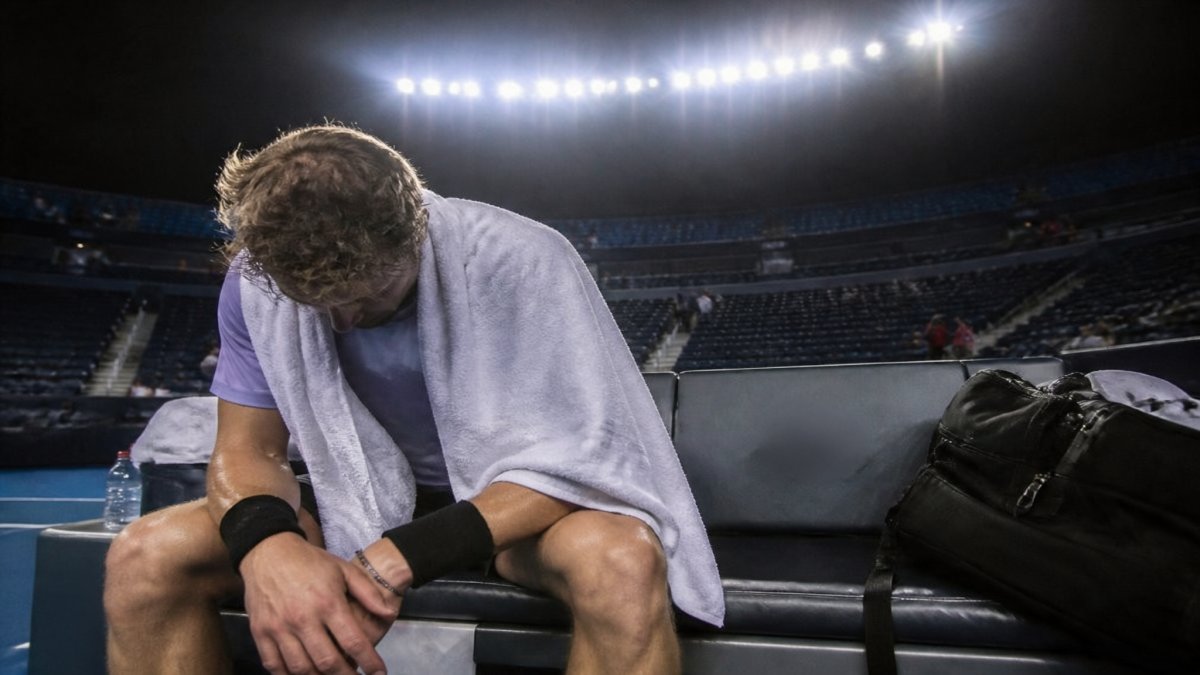
Exhausted tennis player resting on a courtside bench.
The physical toll is real. Muscle recovery takes time, and back-to-back tournaments don't allow for it. Players arrive at events already carrying fatigue from the previous week. And if you win the previous tournament that gives you even less time to make the next venue and deal with the accompanying jet lag, stress and lack of prep.
A common mistake is assuming elite athletes can simply push through. They can, for a while. But the body keeps score, and the injuries eventually catch up.
Many players now talk openly about needing to manage their schedules more carefully, even if it costs them ranking points. That trade-off used to be more rare. Now it's routine.
Fritz's Slow Ball Rant and the Impact of Tennis Ball Changes on Injuries
Taylor Fritz didn't hold back about the balls being used on tour. His argument: the current balls are substantially slower and fluff up more, which changes how matches play out, putting more strain on players than the balls used before.
The impact of tennis ball changes and recent moves to slow the courts is one of the least understood factors contributing to fatigue in the professional tennis world.
A tennis ball is a pressurized rubber core wrapped in a felt cloth shell. Two variables drive how it behaves off the racquet: internal pressure and the thickness and texture of the felt.
This impacts the arm because of how force travels through the kinetic chain. To generate the same ball speed off a slower ball, a player has to swing harder. More racquet-head speed means more load on the shoulder, elbow, and wrist at contact. Over a two-hour match, that's hundreds of extra high-effort swings. Over a season, it's the difference between manageable soreness and a chronic issue.
Fritz's frustration isn't just about how the ball feels, it's about consistency. Different tournaments use different balls, some events run their own branded ball, and according to Fritz, the balls he buys at the tennis store aren't matching the Tournament-approved balls due to the way they feel on the court. Players are having to recalibrate their timing and swing path week to week. That constant recalibration is its own tax.
There's also a surface interaction most fans miss. Ball felt degrades quickly due to the level of grit in hard court surfaces. On a rough hard court like Indian Wells the felt fluffs up fast, which slows down match play. On grass, the felt stays cleaner and the ball plays faster longer. So the same ball can play differently depending on the surface.
For grinders who favor long baseline rallies, slower balls mean longer points. But longer points mean more wear on the body. The math isn't complicated, but the mechanism is worth understanding: it's not one bad ball, it's the compounding effect of inconsistent brands and court specs across a season that already leaves no room for recovery.
Zverev and the Tennis Court Surface Speed Controversy
Alexander Zverev has claimed that courts are being slowed down deliberately, and he's pointed at the tour's biggest stars as the reason. His argument: slower surfaces favor Sinner and Alcaraz - who the tournaments want to reach the final because they are bigger draws. This could mean millions of extra dollars in revenue.
Slower play also reduces the amount of easy points that big servers like Zverev and Fritz can get when the ball flies through the court more freely. Slower courts mean longer rallies, effectively neutralizing the serve-and-volley game and rewarding long, grinding points from the baseline.
Zverev's comments touch on something interesting: surface uniformity across the tour has made it harder for specialists to thrive. Players who built their game around fast courts or serve-and-volley points are now increasingly finding that court conditions play slower and more like clay.
Here's what most coverage misses: surface speed isn't just about aesthetics. It affects injury risk. Hard courts are already punishing on joints, and slower hard courts extend the points, which extends the pounding the player must endure.
The Economics Behind Tournament Decisions
Tournament organizers face a straightforward incentive: sell tickets, sell broadcast rights, and keep the biggest names on court as long as possible. That pressure shapes decisions about court speed, ball selection, and scheduling, and it's the part of the debate that rarely gets said out loud.
What This Means for the Future of the Tour
Change is possible, but it won't happen without pressure. Players are increasingly willing to speak publicly, and that visibility could force the tour to respond.
Issue |
Player Complaint |
Possible Fix |
Impact on Players |
|---|---|---|---|
Congested calendar |
Too many events, no recovery time |
Shorter season, mandatory rest |
Fewer injuries, longer careers |
Ball changes |
Inconstencies strain arms |
Standardized ball specs |
Consistent preparation and play |
Court speed |
Slowed down for entertainment |
Surface variety change |
Rewards diverse styles |
Scheduling demands |
Back-to-back tournaments |
Offer adequate rest between events |
Better recovery, longer careers |
Conclusion: A Sport at a Crossroads
The tour schedule burnout debate isn't going away. Alcaraz, Fritz, and Zverev have put the issue on the record, and the questions they're raising won't be answered by ignoring them.
Frequently Asked Questions
Why are top tennis players complaining about the tour schedule?
Players argue that the current ATP tour schedule leaves almost no off-season for recovery, forcing them to compete nearly year-round. Carlos Alcaraz and others have pointed out that the physical toll of constant travel, back-to-back tournaments, and limited rest leads to injuries and burnout. The congested calendar also affects the quality of matches, as players arrive fatigued instead of fresh and ready to play. Many are calling for a shorter season and mandatory rest periods to protect player welfare and competitive integrity.
What did Alexander Zverev say about court speeds?
Zverev has publicly claimed that some courts are being slowed down to favor certain players, specifically naming Carlos Alcaraz and Jannik Sinner. While the ATP has not confirmed any intentional manipulation, Zverev's comments have fueled the ongoing debate about surface and play style uniformity and whether playing conditions are being tailored to favor specific playing styles.
How do tennis ball changes affect player injuries?
Taylor Fritz and other players have complained that recent ball changes make the balls heavier and slower, and pro players have to swing harder to stay competitive. The impact of the lack of tennis ball uniformity directly affecting injuries on-court is a growing concern, as the cumulative effect of hitting heavier over a long season can strain muscles and joints, contributing to long-term damage.